
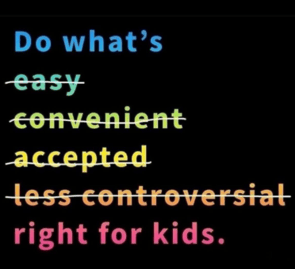
“Do what’s easy convenient accepted less controversial right for kids.”
-Unknown
There was once an unspoken belief that schools and the adults who served children would make decisions based on what was best for students and their future. While that goal still exists, today’s world often pulls us in different directions. Public opinion, social pressures, convenience, and the desire to avoid conflict can sometimes influence decisions more than the long-term needs of children. The challenge before us is simple to state, yet difficult to live out: do what is right for kids, even when it is not the easiest path.
Consider the idea that everything should be easy for children. Society has increasingly embraced an “everyone gets a trophy” mentality, where protecting feelings can sometimes take priority over teaching resilience. Yet life does not operate that way. There are victories and disappointments, successes and failures. Both teach valuable lessons. Winning can build confidence, but losing can build character, persistence, humility, and determination. Children grow not by avoiding challenges but by learning how to overcome them.
The same can be said about convenience. When has life ever truly been convenient? Life is often unpredictable and filled with obstacles we never anticipated. One of the most important skills we can teach children is how to adapt when things do not go according to plan. If we remove every inconvenience from their path, we may unintentionally rob them of opportunities to develop perseverance, problem-solving skills, and flexibility. Growth rarely happens in comfort zones.
Another common trap is doing only what is widely accepted. The problem with acceptance is that it is often based on opinion rather than principle. What is accepted by one group may not be accepted by another. History is filled with examples of people who challenged accepted norms and, in doing so, made the world better. If our primary goal is acceptance, we risk limiting creativity, curiosity, and independent thought.
Perhaps the easiest path of all is choosing what is least controversial. Avoiding disagreement can feel safe, but meaningful growth often requires difficult conversations and the courage to think differently. As Seth Godin often suggests, it is okay to “create a ruckus.” Innovation, progress, and authenticity rarely emerge from playing it safe. They emerge when people have the courage to be themselves and stand for what they believe.
Of course, controversy for its own sake serves no purpose. The focus should always be on respecting the dignity and rights of others. Reading a challenged book, expressing individual beliefs, or choosing how to live one’s life are not inherently controversial acts. They are personal choices. In a free society, many of those decisions belong to the individual, not to those observing from the sidelines.
Ultimately, our responsibility is not to choose every path for children. Our role is to guide, coach, support, and prepare them. We help them develop the knowledge, skills, values, and confidence needed to make their own decisions. When we prioritize what is truly best for children rather than what is easiest, most convenient, most accepted, or least controversial, we empower them to develop their own moral compass and navigate life with purpose and integrity.
The goal is not to raise children who simply follow directions. The goal is to raise adults who can think, choose, and lead themselves well. That is what it means to do what is right for kids.
Start Your Day with Intention
What decision might I face today where choosing what is right could be harder than choosing what is easy, and how will I respond when that moment comes?
End Your Day with Insight
Looking back on today, when did I prioritize growth, integrity, or long-term benefit over comfort, convenience, or approval, and what did that experience teach me?


Leave a Reply